Share

Share on facebook Share on facebook Share on facebook

Michigan FY27 Budget Includes $5 Million for Supportive Services Transformation Fund (SSTF)

CSH applauds Governor Whitmer and the state legislature for their continued bipartisan support of this funding, which has delivered measurable results, helping more than 1,800 individuals secure and maintain housing while accessing supportive services. 

Michigan Governor Gretchen Whitmer signed the FY27 state budget this week, which includes a $5 million investment in supportive housing services to help individuals and families achieve long-term housing stability. Administered by the Michigan Department of Health and Human Services, the funding will enable supportive housing providers statewide to add capacity and provide intensive, person-centered services to residents. Supportive housing combines stable, affordable housing with services for people with disabilities and long histories of homelessness. It is a proven, accountable, and cost-effective approach to lasting stability.

This funding follows previous appropriations totaling $31 million for supportive housing services between FY2023 and FY2026. The impact of that investment is measurable, transparent, and already evident: 98% of residents served through this funding have remained stably housed, and 63% have maintained or increased their income. These results show that when people receive the help they need, they can break the cycle of homelessness, achieve better health outcomes, and reduce reliance on costly public systems. State lawmakers are making public investments that produce lasting stability while reducing reliance on more expensive emergency and crisis services.

CSH thanks state Senators Jeff Irwin, Sylvia Santana, and Sarah Anthony, state Representative John Roth, and House and Senate leadership for their continued bipartisan support for this impactful investment.

CSH is also grateful to all the individuals and organizations in the state who have advocated for supportive housing, in particular, Avalon Housing, Communities First, Faith in Action, Goodwill of Northern MI, ICCF Community Homes, and Room at the Inn, all of which hosted tours for legislators this year or provided committee testimony.

“Every dollar Michigan invests in supportive services goes toward something measurable: helping people obtain stable housing and build healthier, more secure futures,” said Catherine Distelrath, Michigan Director at CSH. “We look forward to continuing our partnership with state leaders, providers, and advocates to expand these measurable results across the state.

Share

Share on facebook Share on facebook Share on facebook

CSH Statement on the Department of Justice’s Memo on Olmstead and Community Integration

On June 19th, just days before the 27th anniversary of the Supreme Court’s decision in Olmstead v. L.C., the Department of Justice (DOJ) issued a memo advancing an interpretation of the Olmstead decision that breaks from decades of established precedent. The memo questions whether the Olmstead decision requires states to serve people with disabilities in the most integrated setting appropriate to their needs. As the DOJ acknowledged, the new interpretation is out of step with how federal courts have understood Olmstead since 1999.

CSH is deeply concerned about this departure. Defending and advancing Olmstead is central to our work. The core principle— that people with disabilities should be able to live, work, and thrive in the community of their choice — is the foundation of supportive housing. At its heart, Olmstead recognized that no one should be cut off from their families, friends, and people they love simply to receive the care they need.

Olmstead has shaped how states support people with disabilities for nearly three decades. Courts across the country have consistently affirmed its core principle: that unnecessary isolation is a form of discrimination. That principle has guided state investment and practice. It has moved systems toward community-based housing and services that help people achieve stability, health, and independence. 

This does not mean that treatment and housing are at odds. Some people, at some point in their lives, need intensive clinical care, including time-limited stays in hospitals or residential settings. A strong system includes that full continuum, but those settings work best as a bridge to stable community living, not a substitute for it. The choice is not between treatment and housing. Both are essential, and neither works in isolation.  

The harder truth is that legal standards are only part of what stands between a person and a life of their choosing in the community. America faces a severe shortage of affordable housing and wide gaps in access to care. Efforts to expand access to evidence-based treatment supports, particularly community-based models, would be more effective than focusing on compelling services that simply are not available. These realities do more than any legal interpretation to determine whether someone with any disability including serious mental illness stays housed or falls into homelessness. Without a stable home, too many people either languish in institutional care or leave institutional care only to cycle back through emergency rooms, shelters, and jails.

Our FUSE work had demonstrated for more than two decades that when communities prioritize intensive services with housing, even people with the most complex needs find stability and recovery while communities enjoy reduced homelessness and costs associated with institutionalization.

North Carolina shows what is possible and what it takes to ensure that people have freedom of choice and the opportunity to thrive. Before 2012, the state relied on large, segregated adult care homes to serve people with serious mental illnesses. Those conditions resemble what this memo would now treat as legally acceptable. The DOJ found that this reliance violated the ADA and Olmstead, and that the resulting agreement required the state to build supportive housing and community-based services.

Building that capacity took the state more than a decade, several extensions, and sustained public investment, and the work continues today. The work required new levels of cross-sector collaboration between the housing and health sector state and community leaders.  That investment has helped thousands of North Carolinians leave institutional settings for homes of their own.

The DOJ memo targets the very tool that drove progress. North Carolina’s problem was a shortage of housing and services. The legal expectation to integrate is what finally pushed the state to address the shortage. Removing that expectation, while the capacity gap remains, abandons people in the middle of a transition that is finally helping them.

Stepping back from community-based housing and services will push more people, and more cost, onto public systems. Institutional and crisis care is much more expensive than supportive housing, by many estimates more than three times as much per person. Without stable housing to exit to, that spending recirculates through repeated hospitalizations, law enforcement contacts, and time in jail, with little lasting stability to show for it.

The evidence of the last quarter century points in one direction. Supportive housing and community-based care improve health, strengthen communities, and reduce reliance on costly crisis systems. As policymakers and state leaders study this memo, the strongest path forward is to follow the evidence and build on community integration for people with disabilities by: expanding supportive housing, strengthening access to mental health and substance use care, and ensuring a full continuum of support that meets people where they are.

CSH remains committed to working with federal, state, and local partners so that every person has access to safe, stable housing and the support they need to thrive in the community.

Share

Share on facebook Share on facebook Share on facebook

New York City Expands Supportive Housing Eligibility for People Leaving Incarceration

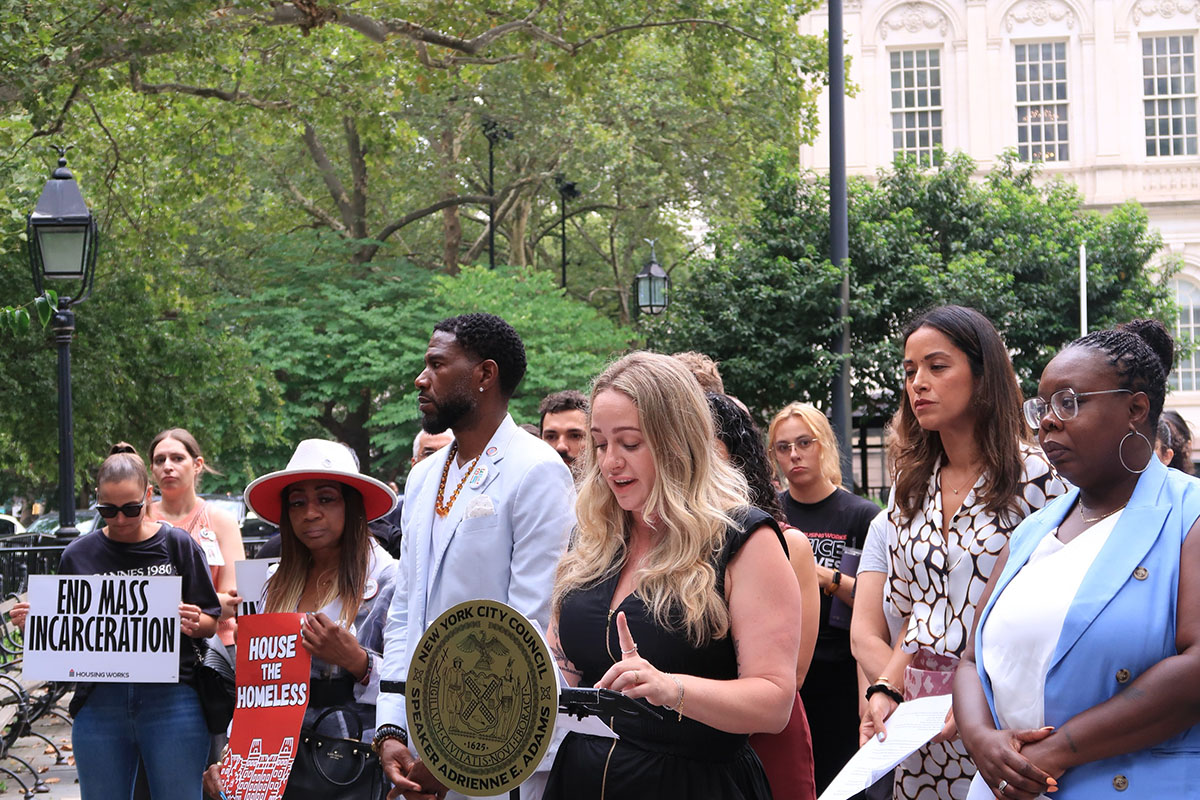
Yesterday, the New York City Council passed Intro 1100-A, a new law that expands access to City-funded supportive housing for individuals transitioning out of incarceration. CSH led advocacy efforts for the bill, working closely with local partners. Council Member Carlina Rivera sponsored the legislation and built support among her colleagues.

At a press conference outside City Hall, Lauren Velez, Director of CSH’s Metro NY Team, explained why passing the new law is so important:

“Too often, our neighbors leaving Rikers get trapped in a cycle of homelessness and incarceration without ever receiving the services and support they need to stabilize their lives. Intro 1100 changes that,” Velez said. She added, “When people cycle through homelessness and incarceration, it’s costly for New York taxpayers and makes our communities less safe.”

Velez was joined by Council Member Rivera, Comptroller Brad Lander, Public Advocate Jumaane Williams, and representatives from the Supportive Housing Network of New York, Fortune Society, Freedom Agenda, Urban Pathways, and Coalition for the Homeless.

Read City Limits op-ed written by Lauren Velez and Council Member Carlina Rivera.

What the Law Changes

Before this legislation, a person experiencing homelessness and who was incarcerated for 90 days or longer would have the jail time considered a “break” in homelessness, and none of their time in jail could be counted toward eligibility for supportive housing.

Intro 1100 ensures that anyone who enters jail as a person who is homeless will continue to accrue time toward eligibility. CSH has long maintained that any kind of institution, particularly a jail, should never be considered a home in any circumstance.

Why It Matters

The need for reform is urgent. In 2023:
– One-third of people admitted to NYC jails were unhoused before incarceration.
– More than 40% of people released from state prisons to NYC entered shelters immediately.

Supportive housing is a proven solution for people who cycle between homelessness and incarceration—especially those living with mental illness or substance use disorders. In contrast, punitive approaches like forced treatment or incarceration often fail to connect people to long-term housing and services.

Acknowledgments

CSH thanks Council Member Rivera, Comptroller Lander, Public Advocate Williams, and the “Jail is Not a Home” committee members who helped make this legislation possible:

– Lily Shapiro, Fortune Society (co-chair)
– Tierra Labrada, Supportive Housing Network of NY (co-chair)
– Kandra Clark, Urban Pathways
– Gary Jenkins, Urban Pathways
– Alison Wilkey, Coalition for the Homeless
– Sarita Daftary, Freedom Agenda
– Dr. Victoria Phillips, Community Advocate
– JJ Parish, Urban Justice
– Reggie Chatman, Fortune Society

Share

Share on facebook Share on facebook Share on facebook

CSH Statement on Senate Passage of the Reconciliation Bill

CSH Calls for Balanced Policy That Protects Both Housing and Health Supports

The Senate’s passage of the reconciliation bill presents a deeply mixed outcome for the supportive housing field. While we acknowledge the inclusion of important housing provisions such as expanding and making permanent the Low-Income Housing Tax Credits and the New Markets Tax Credit, we cannot overlook the harmful trade-offs embedded in this legislation.

These housing investments, while significant, are not sufficient to offset the damage caused by provisions that undermine access to essential healthcare and basic supports for people experiencing homelessness and housing instability. The bill imposes new barriers to Medicaid and nutrition assistance that will disproportionately impact individuals with complex health and housing needs. These are the very people supportive housing is designed to serve.

Supportive housing succeeds because it pairs affordable homes with the services that help people stay housed and maintain their health. When the government restricts access to those services, it weakens the entire model. Limiting state Medicaid funding tools, imposing burdensome recertification requirements, and expanding work requirements for vulnerable populations all threaten the stability and well-being of those we serve.

CSH remains committed to advancing effective policies that recognize the interconnectedness of housing, healthcare, and human services. We urge Congress to consider the full impact of this legislation, not just its housing investments, but also the barriers it creates for those most in need and the burdens it places on the communities in their districts. We will continue to work with partners across sectors to ensure that supportive housing remains a viable and effective solution to homelessness and housing insecurity.
 
Deborah De Santis
CSH President and CEO

Share

Share on facebook Share on facebook Share on facebook

A Powerful New Documentary “Returning Home” Explores How Supportive Housing Creates Second Chances and Safer Communities

New York, NY | May 22, 2025 — A powerful new documentary, Returning Home: Prison, Homeless, or Housing? The Choice That Changes Everything explores innovative Ohio reentry programs that create second chances, prevent recidivism, and build safer communities.

Produced by CSH in collaboration with Invisible People, Returning Home premiered this week on YouTube and features candid interviews with supportive housing tenants, including those once on death row, as well as the case managers and landlords who support second chances. Prisons discharge people after serving their sentence often without an ID, job, or a home to return to, and the film reveals what happens in communities that prioritize housing and services to reduce street homelessness and the homeless-to-prison cycle.

“At a time when communities are grappling with rising homelessness, shrinking budgets, and a shortage of affordable housing, Returning Home delivers a clear message that supportive housing works,” said Deborah De Santis, President and CEO of CSH. “Time and time again, we have proven that supportive housing makes the difference in helping people thrive while being cost-effective. This film is a call to action for policymakers to invest in what truly makes communities safer and stronger.”

The film highlights CSH’s innovative Returning Home Ohio (RHO) and Community Linkage Program, administered in collaboration with the Ohio Department of Behavioral Health. With a recidivism rate of just 3% for tenants supported by RHO and 1.4% for those in Community Linkage, the results prove that supportive housing is effective at helping people stay housed long term and prevents them from engaging in criminal activity thereby making communities safer.

“We are grateful to our Ohio agency, housing, and services partners who have helped more than 2,300 people find stable housing and avoid returning to prison,” said Leah Werner, Director of CSH’s work in Ohio, Kentucky, and Tennessee. “As I say in the film, ‘providing access to housing and services is the formula.’ These programs prove that when we invest in people, we reduce recidivism and rebuild lives.”

The film premiered on YouTube on May 21.

Watch the trailer and learn more at: https://csh.org/returninghomefilm

Media Contact: Jesse Dean, CSH, [email protected] | 347.931.0132

###

Share

Share on facebook Share on facebook Share on facebook

City Council Approved NYC Budget Restores $6.4M in Funding for Justice Involved Supportive Housing

For Immediate Release | Media Contact: Jesse Dean, [email protected] or 347-931-0132

The appropriation will provide critical funding for 500 supportive housing units that can end the jail-homelessness cycle for people exiting Rikers. 

The New York City Council passed the fiscal year 2025 budget, allocating $6.4 million to fund 500 Justice Involved Supportive Housing (JISH) units for individuals leaving Rikers. This funding is critical for providing supportive housing units that greatly increases the chances for persons with a history of homelessness and incarceration, to achieve stability, recover from substance abuse disorder, manage mental illness, and finally end the jail-to-street homelessness-jail cycle. 

The allocation fulfills a 2019 commitment from city officials to expand access to the program and was championed by CSH with City Council Speaker Adrienne Adams, Council Members Sandy Nurse and Carlina Rivera, Freedom Agenda, Vera Institute of Justice, The Fortune Society, and other partners.  

Approximately 51% of the population at Rikers, more than 2,500 people each year, struggle with untreated or complex behavioral health conditions. Incarcerating them costs approximately $1.4 billion annually. Without additional housing or support to address their health, many of these individuals upon leaving Rikers, will become homeless or will be re-arrested and return to jail. 

In contrast, supportive housing costs $108 million annually, saving the city significant money while also stopping the homelessness-to-jail cycle and assisting in decarcerating Rikers. The JISH program provides individuals exiting Rikers with the higher-level of support they need to re-enter society and thrive in their communities. Several studies show that supportive housing promotes stability, improves connections to health and behavioral health services, and reduces recidivism.  

“The city fulfilling its commitment is a major victory for our residents with highly complex barriers to housing and for advocates who have long championed the JISH program,” said Lauren Velez, NYC Associate Director at CSH. “With these additional resources, the program can finally reach its full potential and offer crucial support to New Yorkers while saving taxpayer dollars that would otherwise flow to costly emergency response services.” 

“Justice-Involved Supportive Housing is key to increasing public safety and advancing successful re-entry for those returning to our communities from the justice system,” said Speaker Adrienne Adams. “It was one of the many commitments of the plan to close Rikers that remained unfulfilled, because of a shortfall in funding for the vital services that accompany the housing. It has been a Council priority to invest in proven safety solutions and secure the necessary funding for JISH over several budgets, and the Council is proud to invest $6.4 million of its own funding to close the gap for these housing units to be realized. Moving forward, it will require the Administration to baseline these funds and fulfill its obligation.” 

“Supportive housing is a lifeline for justice-involved individuals, offering them stability and a chance to rebuild their lives. We are deeply gratified by the Council’s commitment to fully fund the JISH program, ensuring both the maintenance of current units and the creation of new ones. This crucial investment underscores our dedication to providing real opportunities for successful reintegration and lasting positive change in our communities,” said Council Member Sandy Nurse (D-37). 

“Too often New Yorkers exit incarceration into the shelter system, making it more difficult to successfully reintegrate into the community and achieve stability. Access to supportive housing is an important intervention for individuals involved with the criminal legal system that centers compassion and dignity with access to programming and support. I am proud to have helped secure $6.4 million for JISH and look forward to continued work in coalition to support the most vulnerable residents of our city,” said Council Member Carlina Rivera (D-02).  

Darren Mack, Co-Director of Freedom Agenda said, “We are grateful that City Council responded to the tireless advocacy of formerly incarcerated people and allies to add funding for the JISH program in this year’s budget. Because of their commitment to funding true solutions for community safety and well-being, New York City will finally be able to create 380 more JISH units to break the jail to shelter cycle. We hope the administration will work with providers to get these units up and running immediately.“ 

Jullian Harris-Calvin, director of the Vera Institute of Justice’s Greater Justice New York initiative, said: “We applaud the City Council for securing $6.4 million for Justice-Involved Supportive Housing (JISH). Enabling justice-involved New Yorkers to access housing and supportive services helps interrupt cycles of instability, addressing the root causes of crime and keeping communities safe—all without relying on incarceration, which is costly, deadly, and increases the likelihood of rearrest. In addition, judges are often hesitant to release individuals who are unhoused back to their communities to await trial; greater access to JISH will enable some of the decarceration needed to close Rikers Island once and for all. This investment shows that the City Council is serious about safety, and we commend their focus on preventing crime before it happens rather than just reacting in its aftermath.”

The $6.4 million allocation will enhance the services funding for the 500 JISH units to keep up with today’s services costs, staff wages, and the higher service needs of the JISH population. 

Formerly incarcerated people, housing providers, and advocates from across the city came together to support the JISH request, including 43 organizations and nearly 80 individuals urging their support. 

“CSH is grateful for the leadership of the New York City Council, especially Speaker Adams and Council Members Rivera and Nurse, and an outstanding number of advocates. After last week’s Supreme Court ruling in the Grants Pass v Johnson case, which overturned constitutional protections for people experiencing homelessness and exposes them to fines, arrests, and incarceration, their leadership proves that policymakers have a choice in responding to homelessness with data-driven solutions. We thank them for recognizing that supportive housing is a cost-effective, proven solution for breaking the homeless to jail cycle,” said Deborah De Santis, CSH President and CEO.