For two decades, CSH’s data-driven approach has helped more than 50 communities break the costly cycle of crisis—proving that collaboration works better than silos.
This week, CSH commemorated 20 years of the FUSE (Frequently Used Systems Engagement) initiative—a groundbreaking approach that has helped more than 50 communities build and scale supportive housing interventions for their residents with complex barriers to housing. Since its inception, FUSE has stably housed more than 3,000 individuals who were previously trapped in expensive cycles of crisis services.
Nearly 600 people from around the country joined CSH’s virtual symposium to mark this milestone. The event brought together partners from three communities using FUSE—Mecklenburg County, NC, Bozeman, MT, and Omaha, NE/Council Bluffs, IA—along with a researcher from Urban Institute and a Bozeman supportive housing tenant to share insights, lessons learned, and the lasting impact the program has had on their systems and on the lives helped by FUSE.
The Innovation: When Systems Work Together
The FUSE concept originated more than 20 years ago during an elevator conversation between two New York City commissioners. Martin Horn, then Commissioner of the Department of Corrections, and Linda Gibbs, Commissioner of Homeless Services. Commissioner Horn was tasked by then Mayor Michael Bloomberg to reduce incarceration costs and Commissioner Gibbs was tasked to address a demand for affordable housing while more than 8,000 individuals were residing in the city’s shelters.
In that brief ride, they recognized something profound: each system was independently trying to help the same individuals, consuming enormous resources yet failing to break the cycle. At that moment, they resolved to work together rather than separately to more effectively solve what was the city’s collective challenge.
That insight became the foundation for what CSH would develop into FUSE—a technical assistance framework that helps communities use data to identify people frequently cycling through systems, then coordinate across sectors to provide what evidence shows works: affordable housing paired with support services.
“We have powerful data systems—all of us are collecting enormous amounts of data and trying to create better outcomes for our communities,” Jason Feldhaus, Executive Director of Threshold CoC of Omaha, NE/Council Bluffs, IA, said during the symposium. “But putting those systems together creates an innovative way to identify solutions.”
The Problem FUSE Solves
Across the United States, a small population remains trapped in a cycle of crisis services—shelters, jails, emergency rooms. These frequent system users often have complex needs: chronic homelessness, mental health conditions, substance use disorders, and involvement with the justice/carceral system.
Fragmented responses fail because each system operates independently. A person might be released from jail to a shelter, visit the emergency department for a health crisis, then cycle back through the same systems. Each intervention addresses an immediate crisis but never solves the underlying cause: having no safe, stable home with coordinated support.
“We started [FUSE] to solve jail overcrowding,” Stacy M. Lowry, Director of Community Support Services in Mecklenburg County, NC, explained at the symposium. “We had many individuals stuck in our jails and we needed a new way to work with them. Doing the same old methods of building more jails wasn’t going to solve the issue. We had unmet needs in our mental health systems.” Mecklenburg County is the state’s 2nd most populous county and includes the city of Charlotte.
Lowry described how FUSE enabled a shift in approach: “FUSE allowed us better ownership of our own community. Instead of placing the burden on one system, it allowed us to join together—criminal justice, mental health, homeless provider system. We developed a joint understanding of how we can work together to create better outcomes.”
How CSH Makes FUSE Work
CSH brings more than three decades of expertise in supportive housing development and systems change to help communities implement FUSE. This includes technical assistance in cross-system data matching, stakeholder engagement across health, justice, and housing sectors, and guidance on developing supportive housing interventions tailored to local needs.
The FUSE approach centers on data-driven decision making. Communities identify their highest system users by matching data across homeless services, criminal justice, healthcare, and other crisis systems. This reveals not just who is cycling through systems, but the scale of unmet need and the costs of the current fragmented approach.
“Starting with a data-driven understanding of the people you’re intending to serve” was critical in Denver’s Social Impact Bond Initiative that brought FUSE to scale, according to Sarah Gillespie, Associate Vice President at Urban Institute, who presented evaluation findings at the symposium. “There was a population that was frequently experiencing homelessness. Once this list came to life based on data, they saw there was a much larger population that needed supportive housing.”
Gillespie noted that this data-driven approach helped reframe supportive housing beyond just a housing solution: “Supportive housing came to be seen not as a housing solution, but came to be one of the city’s criminal justice solutions and healthcare solutions.”
Evidence: FUSE Delivers Results
Twenty years of implementation across diverse communities—urban and rural, across all regions—has generated compelling evidence that FUSE works.
Urban Institute’s evaluation of Denver’s Social Impact Bond Initiative found that 86% of participants remained in stable housing after one year, with most maintaining stability even after three years. These outcomes were achieved among people with the highest previously unmet needs.
The impact extended well beyond housing stability. Speaking at this week’s event, Gillespie shared: “We found really significant outcomes across criminal justice and health care systems. We found a 40% reduction in arrests and a 30% reduction in jail stays. This is meaningfully breaking that homelessness-jail cycle.” The evaluation also found a 40% decrease in emergency department visits, while community-based healthcare visits increased by 155%, which was evidence that people were accessing appropriate and preventative care rather than using emergency services for routine needs.
“About half of the total cost of the supportive housing program was offset by these other outcomes,” Gillespie noted.
In Mecklenburg County, the evidence was similarly powerful. “We saw housing stability increase and it broke the cycle of recidivism and homelessness,” Lowry said during the panel discussion. “The success of MeckFUSE provided the county with the evidence to further invest in this area of need.”
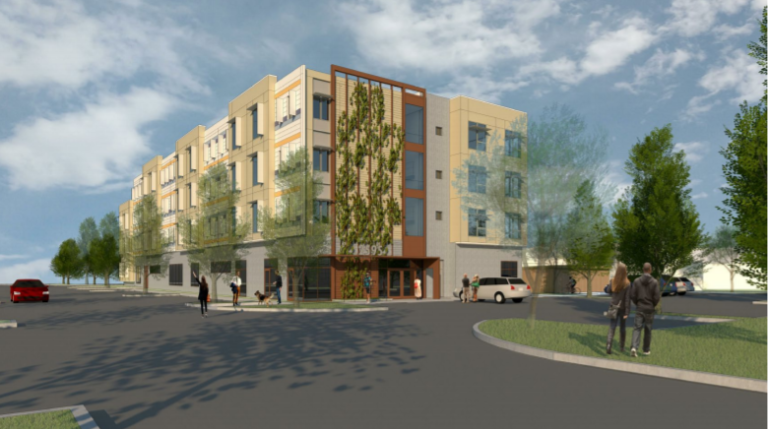
Housing First Village in Bozeman, Montana, demonstrates FUSE’s impact in rural communities. Greg Overman, Supportive Housing Manager at HRDC, shared at the symposium: “Over four years, we’ve had zero evictions. There are three individuals here who have lived here for four years—if you look at their histories, it totals 70 to 80 years of homelessness.”
The Human Impact
Behind the data are individuals whose lives have fundamentally changed. Cori Wilson, a tenant at Housing First Village who joined the symposium, described her transformation: “The people that live there, we are a community. We can be social and feel like a normal person. I get help with substance abuse treatment. They help me get to therapy. Now I have a stable environment for my daughter.”
Wilson shared that with support, she has been able to maintain sobriety, secure stable housing for two years, and reunite with her child. “You have to have the programs to have people succeed in life,” she said.
Overman shared another resident’s perspective during the panel: “We have a resident here that lives in Unit F and she likes to say ‘F is for Forever.’ Her barriers that led to her being on the FUSE list aren’t magically going away. But she celebrated four years of housing stability after almost 30 years of homelessness.”
Reflecting on participant feedback from Mecklenburg County, Lowry noted that connection to community emerged as a top priority for FUSE participants. “We heard over and over—the connection to community. Being able to foster connections with parents, children, was high on people’s list for what they were able to accomplish in their first year of housing. Fostering those relationships were one of the things they were most proud of.”
Why FUSE Matters Now
As communities across the country face pressure to address homelessness and rising costs across health, justice, and social service systems, at the same time that the federal government shifts funding away from affordable housing and services, FUSE offers a proven path forward. The approach demonstrates that coordinated, data-driven intervention is more effective and more cost-efficient than fragmented crisis response.
“FUSE continues to be the strategy that allows us to address our most vulnerable populations,” Feldhaus reflected at the symposium. “We see FUSE really target our ability to work for fiscal sustainability and deliver quality services. This targets the neediest individuals in a way that makes sense for the future with a strategy that’s long term and proven.”
The evidence is clear: communities can reduce public spending, alleviate pressure on health and justice systems, and create pathways to stability for those most in need. Investment in supportive housing is not just compassionate—it’s sound fiscal policy.
“FUSE is replicable—you can do it in urban areas, rural areas, red states, purple states, blue states,” Lowry emphasized. “FUSE works.”
Resources and Next Steps
CSH released a FUSE 20th Anniversary Brief showcasing two decades of impact through case studies from four communities that successfully implemented FUSE. The brief highlights transformative outcomes across healthcare, justice, and housing systems, demonstrating how FUSE moves people from crisis to stability.
Learn more about how FUSE can work in your community. View a recording from CSH’s FUSE 20th Anniversary Symposium, visit CSH’s FUSE resources or contact us to explore bringing this proven approach to your region.